Indiana’s Quiet Earthquake Risk: A Neighborly Guide to the Great ShakeOut


On Thursday, October 15, 2026, at 10:15 in the morning, something quiet and a little remarkable will happen across Indiana. Students in classrooms from Evansville to Fort Wayne, workers in Indianapolis offices, and folks in their kitchens in small towns like Mitchell and Marengo will stop what they are doing and drop to the floor for an earthquake drill.
It is called the Great Central U.S. ShakeOut, part of an annual earthquake drill in which millions of people around the world practice a simple technique: Drop, Cover, and Hold On. It takes about a minute and costs nothing. In a state that few people associate with earthquakes, it may be the most useful minute of the month.
We are not writing this to scare anyone. We are writing it because knowing what to do before you need to is about the most neighborly thing you can do for your own household and the people next door. No doom. No pitch. Just a few practical steps that fit into an ordinary Hoosier life.
Indiana’s Hidden Seismic Story
Most Hoosiers do not realize that Indiana sits near two of the most significant earthquake zones in the central United States: the New Madrid Seismic Zone and the Wabash Valley Seismic Zone. The second one matters most for southwestern Indiana.
The New Madrid Seismic Zone, centered near the Missouri bootheel, produced some of the largest earthquakes in North American history during the winter of 1811 and 1812. The shaking was strong enough that church bells reportedly rang as far away as Boston, and the Mississippi River briefly ran backward.
The Wabash Valley Seismic Zone runs along the border of southwestern Indiana and southeastern Illinois. Geologists have found evidence in the soil of large prehistoric earthquakes there, and the zone is still active. A magnitude 5.4 earthquake struck southern Illinois in 1968, and a magnitude 5.2 near Mount Carmel, Illinois, in April 2008 rattled windows across much of Indiana.
For Evansville and the communities around it, the Wabash Valley zone is a real and well-studied hazard. A strong earthquake there would bring noticeable shaking to southwestern Indiana, and a major New Madrid earthquake would be felt across most of the state.
Does that mean an earthquake is coming soon? No. It means the possibility exists, and being ready costs next to nothing. As Jefferson Howells, director of Emergency Preparedness at Purdue University, put it ahead of last year’s drill: “While damaging earthquakes are rare in Indiana, smaller earthquakes occur one to two times per year.”
What Actually Happens During the Drill

At 10:15 a.m. on October 15, participants practice three actions:
- Drop where you are, onto your hands and knees. This keeps the shaking from knocking you down and leaves you low enough to crawl to shelter if you need to.
- Cover your head and neck with one arm and hand. If a sturdy table or desk is nearby, crawl under it. If not, stay low beside an interior wall, away from windows, and protect your head and neck with your arms.
- Hold on to your shelter with your free hand until the shaking stops. If you are under a table, grip one of its legs so you can move with it if it shifts.
If you are outdoors, move away from buildings, utility poles, overhead wires, and parking garages if you can do so safely. If you are driving, pull over to a clear spot, stop, and stay in the vehicle until the shaking ends.
Taking part is entirely voluntary, and it is meant to be easy. You can register at ShakeOut.org for details on running a drill, or you can simply gather the family and do it at home. The goal is not a perfect drill. The goal is a familiar one.
A Household-Sized Preparedness List
This is not a survival guide or a gear review. It is a short list of things you and your family can do this month to be a little readier for an earthquake, or for any time the power goes out.
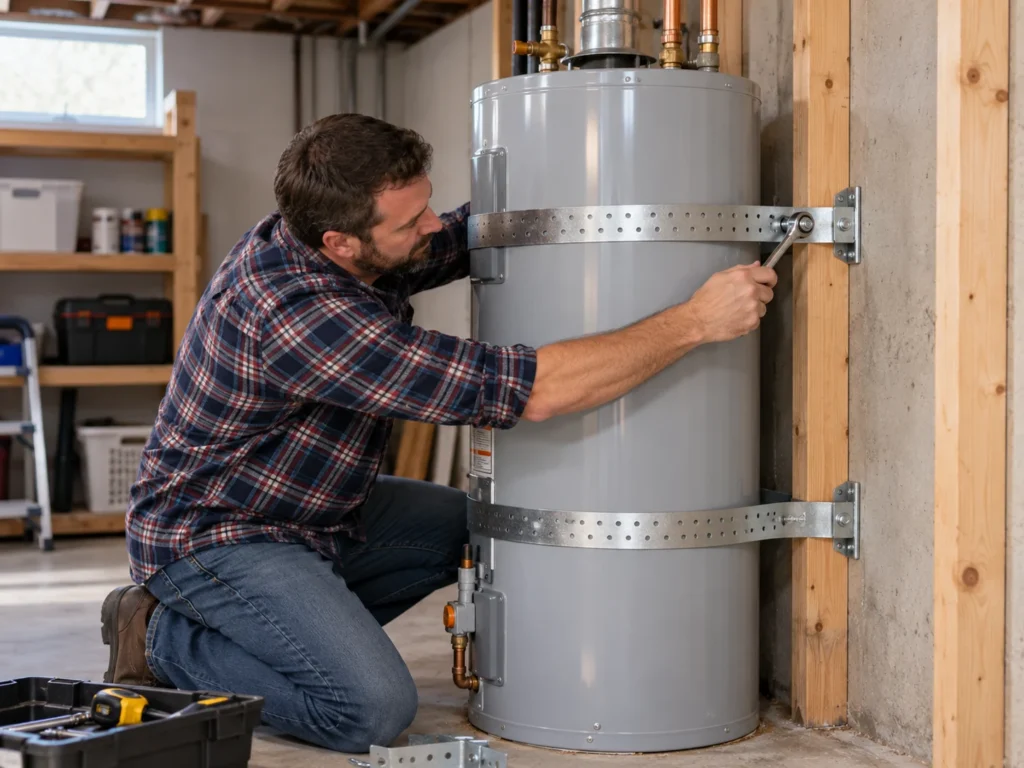
- Strap your water heater. This is one of the simplest things you can do. An unsecured water heater can topple in an earthquake, which can mean a broken gas line, a flooded basement, or a fire. A strapping kit from the hardware store is inexpensive and takes about an hour to install. Use heavy-gauge metal straps, not plumber’s tape, and anchor them to the wall studs.
- Anchor tall furniture. Bookcases, dressers, and televisions can slide or tip during strong shaking. Fasten them to the wall studs and keep the heaviest items on the lowest shelves.
- Know where your gas shutoff is. Find the valve at your meter now, and learn how to close it, so you are not hunting for it later. Only shut the gas off if you smell gas or hear it hissing, and once it is off, leave it off until the gas company comes to turn it back on.
- Keep shoes and a flashlight by the bed. Cuts from broken glass are among the most common earthquake injuries. If the power is out, a pair of sturdy shoes and a flashlight within reach will let you move through the house safely in the dark.
- Keep three days of food and water on hand. This is where a well-stocked pantry earns its keep. Nobody is asking you to build a bunker or store a year of rations. Three days of the food your family already eats, plus about a gallon of water per person per day, is enough to get through the first stretch of most emergencies. If you already keep a deep pantry, buying extra rice and canned goods when they are on sale, you are ahead of most.
One Minute That Matters
The Great ShakeOut is not about fear. It is about community. It is schools and workplaces and families all practicing the same simple motion at the same moment, so that if the real thing ever comes, nobody is frozen wondering what to do.
It is also a reminder that preparedness is not a hobby for a certain kind of person. It is a habit for anyone who wants their household to be a little steadier when the unexpected arrives. Strap the water heater. Secure the bookcase. Know where the gas valve is. Keep a flashlight by the bed. That is not prepping. That is just being a good neighbor to yourself.
On October 15 at 10:15 a.m., we will be dropping, covering, and holding on. We hope you will join us.
For more information, or to register your household, school, or business, visit ShakeOut.org.